
Beginners rarely struggle with yoga itself. They struggle with the twenty minutes before the first class, which is a different problem and a much more solvable one. What follows is the answer the school gives on WhatsApp several times a week, written out properly.
The two decisions that actually matter
Everything else is noise. The first is when. Pick a slot you can repeat, not the one that sounds most virtuous. A class you attend at six in the evening three times a week beats a 5.30 am class you attend twice and then resent.
The second is which course, and for a genuine beginner there is really only one answer at this school: Classical Hatha Yoga, the basic-level course, which assumes no experience whatsoever. Roughly half of every intake has never been on a mat.
What happens in a first class
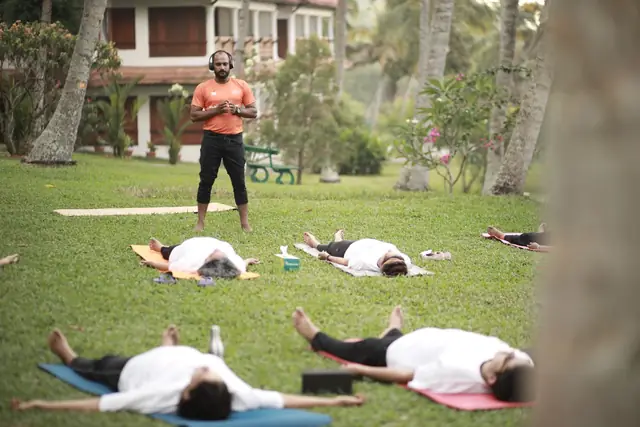
You will not be asked to do anything dramatic. A first session starts with breathing and warm-ups, moves through standing postures, and finishes lying down in savasana while somebody talks you through relaxing parts of your body you did not know were tense.
Nobody will look at you. This is the fear that stops most people, and it is the one that dissolves fastest: everyone else in the room is upside down, concentrating, or thinking about their own hamstrings.
You will be corrected. That is what you came for. A correction is not a criticism, and in a hatha class it is usually called out to the whole room rather than delivered to you personally.
What to wear and bring
- Clothes you can fold forward in and that will not ride up when you invert. Anything you would exercise in works.
- A mat if you own one. If you do not, come anyway and ask.
- An empty stomach. Two hours after a meal is the ordinary rule and it matters more than you expect once you reach the twists.
- Water, and the willingness to not drink it during the practice.
The five things beginners worry about
"I am not flexible." Flexibility is an outcome, not an entry requirement. It is the single most common reason people give for not starting and the one with the least behind it.
"I will be the worst in the room." Probably, on day one, and nobody will notice or care. This changes faster than anything else.
"I will not keep it up." This is the real one. It is why the school teaches a fixed sequence you eventually know by heart: a practice that needs no decisions survives a bad week, and a practice that needs a decision does not. If consistency rather than technique is your problem, Daily Yoga is built around it.
"I am too old." The school has students in their sixties writing reviews about starting from scratch.
"My back / knee / shoulder." Say so before you start, not after. Either the postures get modified for you, or you are pointed at the custom class, which is designed around exactly this. What you should not do is stay quiet and work around it in silence.
How long before it stops feeling strange
Sooner than the physical changes arrive. Most students report sleeping better within a few weeks, usually before anything visible has changed in what they can do on the mat. Stiffness moves before strength does.
Give it a month before judging it, and give it that month at a fixed time. The six things the school says a daily practice gives back all depend on the word daily, which is the least glamorous part of the whole business and the part that decides the outcome.
Starting at Avadhuta
The school teaches at Kovalam beach and live online, Monday to Saturday between 5.30 am and 7.30 pm IST. There is no booking system: you message on WhatsApp, say where you are starting from, and get back a course and a time.
Take one trial class before committing to anything. It is the only reliable way to find out whether the room and the pace suit you, and it costs you an hour.