Hala means plough. The finished shape is unmistakable: on your back, legs taken overhead until the toes reach the floor behind you, the torso folded and the weight carried across the shoulders. It is one of the three postures the school has filmed and put on its own channel.
Where it comes from
Halasana is entered from Sarvangasana, the shoulderstand, and that is not a stylistic preference. The shoulderstand establishes the thing the plough depends on: weight carried on the shoulders and the upper arms rather than on the neck.
If you cannot hold a steady shoulderstand, you are not ready for the plough, and dropping into it from lying flat is how people hurt themselves. That is the single most useful sentence on this page.
What it asks of you
The whole back line, from the heels to the base of the skull. Hamstrings lengthen, the spine flexes through its full available range, and the shoulders take load in a position they rarely occupy.
The neck is the part to watch. In a correct plough the cervical spine keeps its curve and the chin does not jam into the chest; the lift comes from the upper back and the arms pressing down. Turning the head while you are in the posture is the classic way to injure yourself, and it should not be done at all.
The traditional benefits
The classical texts and the Sivananda tradition the school teaches from associate Halasana with the thyroid and the abdominal organs, with relief of back stiffness, and with the calming effect that inversions generally have on the nervous system. Students most often report the last of these first.
A note on health. These are traditional claims and the school’s own account of what students describe. They are not medical claims, and nothing here replaces advice from a doctor.
Who should not do it
This list matters more than the benefits.
- Anyone with a neck injury or cervical spine condition.
- Anyone with high blood pressure, glaucoma or a detached retina.
- During menstruation, in most traditional teaching.
- In pregnancy, unless a teacher who knows your case says otherwise.
- Anyone who has just eaten. The plough compresses the abdomen completely.
If any of those apply, there are useful alternatives, and a teacher can give you one in thirty seconds. Ask rather than improvise.
Common errors
- Weight on the neck. If you feel pressure in your throat, come out. The load belongs on the shoulders.
- Forcing the toes down. Feet in the air with a straight spine is a better plough than feet on the floor with a rounded, collapsed one.
- Turning the head. Never, while loaded.
- Coming out fast. Roll down one vertebra at a time with the hands supporting the back.
Watch it, then be watched
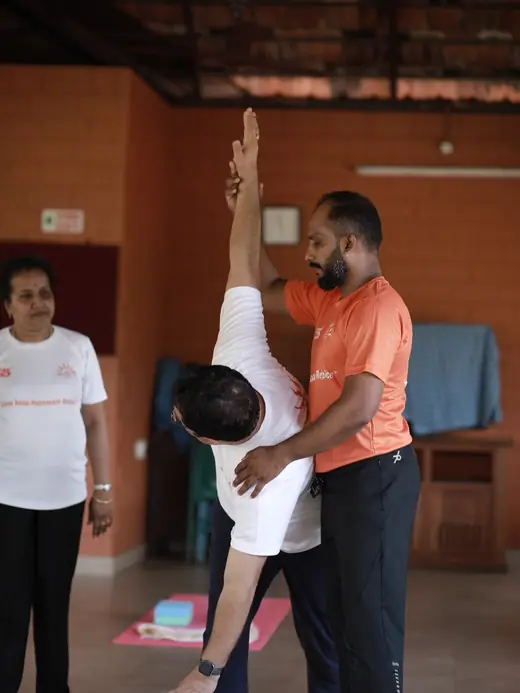
The school’s film takes the posture apart properly, and it is worth watching the entry rather than the final shape. But a film cannot see you, and almost everything that goes wrong in an inversion goes wrong in a way the person doing it cannot feel.
If you want to work on Halasana seriously, do it in a class. The school teaches seven courses at Kovalam and live online, and inversions appear in the classical hatha syllabus once the foundations hold.