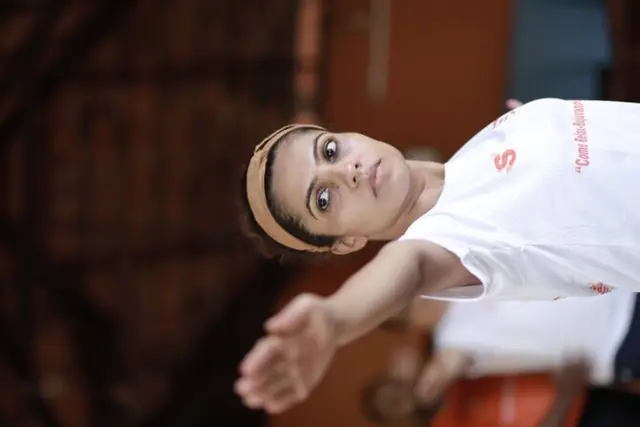
Ardha means half. The full Matsyendrasana is a considerably more involved posture; the half version is the one that appears in nearly every hatha syllabus, including the school’s, and the one the school has filmed.
The shape
Seated, one leg folded in, the other foot planted outside the opposite knee. The torso rotates towards the raised knee, one arm bracing against it, the other hand placed behind you on the floor. That is the geometry, and it is the least interesting part.
Length before rotation
Here is the whole posture in one instruction: you cannot twist a compressed spine. Sit up, lengthen, and only then turn. Most people do the opposite, hauling on the knee with the arm and rotating a spine that has collapsed into the hips.
The rotation should be distributed through the thoracic spine rather than concentrated at the lumbar. If you feel the twist happening in one specific spot in the lower back, you are not twisting, you are shearing.
The braced arm is not a lever. It is a reference point that stops you from sagging. The moment you start pulling on it to get further round, the posture stops being useful.
Where the breath goes
Twists compress. That is the point of them, and it is also why the breath shortens in one and why most people hold it without noticing.
Lengthen on the inhale, rotate a little further on the exhale, and let the depth accumulate over several breaths rather than arriving all at once. This is also the honest test of whether you are in the posture or fighting it: if you cannot breathe evenly, you have gone too far.
The traditional benefits
The classical framing associates the seated twists with the digestive organs and the spine: mobility through the whole length of the back, and a massaging effect on the abdomen. Students most reliably report that it relieves the specific stiffness that comes from sitting at a desk, which is why it turns up in the school’s corporate workshops more than in any other course.
A note on health. These are traditional claims and the school’s account of what students describe, not medical claims. If you have a spinal condition or a disc injury, ask a doctor and tell your teacher before practising twists.
Four errors
- Pulling with the arm. The arm braces; it does not lever.
- Letting the sitting bones lift. Both should stay down. When one lifts, the twist has migrated into the hip.
- Turning the head first. The head goes last, and only as far as the neck is comfortable.
- Chasing depth. A shallow twist on a long spine does more than a deep one on a collapsed spine, every time.
Both sides, equally
Hold for the same number of breaths on each side even though one side will always feel better than the other. The asymmetry is information about how you sit, stand and carry things, and the practice is where you address it rather than confirm it.
To be corrected in person rather than reading about it, the school teaches seven courses at Kovalam and live online.